When Aniello Palma walks into the School of Chemistry at University College Dublin these days, he does so as a principal investigator with his own group, his own lab, and his own research program. It is also the building where, years earlier, he completed his Ph.D. as a student in Donal O’Shea’s group. Between those two moments lies more than a decade abroad – London, Cambridge, a first faculty post in England – and the slow, deliberate work of becoming an independent scientist. The return was not only professional. “After over a decade abroad, my Irish wife and I were thrilled there was an opportunity to finally move back home with our two daughters,” he says. For Palma, the move to UCD was a rare alignment of two things that do not always coincide in an academic life: the right place to do the science, and the right place to live a life.
“After over a decade abroad, my Irish wife and I were thrilled there was an opportunity to finally move back home with our two daughters.”
He is candid about the professional half of that calculus. UCD’s School of Chemistry, he says, offered exactly the environment his program needed: state-of-the-art infrastructure and a proximity to diverse research centers that makes cross-disciplinary collaboration almost frictionless. “It is the ideal environment for my research program to thrive,” he says. That the institution also happened to be where his own scientific story began only deepened the sense of return.
There is a detail about Aniello Palma that he volunteers cheerfully and early, the kind of thing most scientists would bury rather than lead with. “I’m not a peptide scientist by training!” he says. “I am a bit of a latecomer to the party.” It is offered not as an apology but as a point of pride, because the path that brought him to peptides is the same path that shaped the questions he now asks of them.
His doctoral work at UCD, under Prof. Donal O’Shea, focused on the synthesis and application of novel near-infrared fluorophores as sensors and imaging agents, chemistry with little obvious connection to peptide science. From Dublin he moved to London, to Prof. Anthony Barrett’s group at Imperial College London, working on novel CDK inhibitors. From there he joined Prof. Oren Scherman’s laboratory at the University of Cambridge, exploring cucurbiturils as supramolecular building blocks for nanomaterials, chemical diagnostics, and catalytic vessels. Each move deposited a new discipline into his thinking, medicinal chemistry in one place, supramolecular chemistry in another, and each was chosen on purpose. “I’ve always enjoyed moving into new scientific territories,” he says.
It was at Cambridge that the seed of his independent program was planted. Working on cucurbituril macrocycles as Diels–Alderase mimetics, Palma became captivated by the chemistry of confined spaces, by what becomes possible when reactions are forced to happen inside a small, well-defined pocket. When he began developing his own ideas, he went looking for something that would both leverage that multidisciplinary background and clearly distinguish his work from his mentors’. He found it in the literature, in a class of structured, rigid peptides that had been comparatively overlooked in supramolecular chemistry next to the familiar alpha-helices and beta-sheets: polyproline helices. “As a synthetic chemist, the responsive nature of these peptides, with their interconvertible helical conformations, really intrigued me.”
The decision to diverge from everything his supervisors had done was conscious. “I felt it was important to deliberately diverge from my mentors’ work to truly prove my independence,” he says.
“I’m not a peptide scientist by training! I am a bit of a latecomer to the party.”
Described to a fellow peptide scientist, the Palma group’s program reaches back to a foundational idea in supramolecular chemistry and tries to bring peptides into it. As the first synthetic macrocycles capable of host–guest chemistry emerged, so did the notion of using such constructs as enzyme mimetics. “Our team aims to bring peptides back into this equation,” Palma explains, “using them as building blocks for the synthesis of confined, highly functional nanospaces.” A second line carries the same logic of molecular recognition into biology, with the group investigating novel peptide mimetics and peptide-functionalized materials as therapeutic and diagnostic tools, translating the principles of macromolecular recognition into the realm of protein–protein interactions. And a third, newer and still at an early stage, looks further afield entirely: peptide-based energy materials, conceived as green alternatives to the heavy-metal systems in use today.
What ties the directions together, and what sets the group apart, is a willingness to do hard chemistry. “What differentiates us from most groups in the peptide chemistry field is that we do not shy away from organic synthesis and chemical modifications,” Palma says. Many of the amino acids his lab works with are non-proteinogenic, designed, synthesized, and purified in-house rather than ordered from a catalogue. It is a methodological choice that flows directly from his synthetic training, and one that gives the group room to build molecules no supplier sells.
That approach has already borne fruit. In a 2026 paper in Angewandte Chemie International Edition, the group reported a family of all-peptide macrocycles — cyclo-polyprolines built entirely from alternating L- and D-proline tetramers by solid-phase synthesis. The ring behaves as a conformational chameleon, flipping between two distinct shapes depending on the solvent around it, and recognizes guests through an induced-fit mechanism that echoes the way an enzyme reshapes itself around its substrate — a working embodiment of the confined, functional nanospaces Palma set out to build. The study was a collaboration with the Fantuzzi group at the University of Kent, the institution where he first established himself as an independent PI, and it reads almost as a thesis statement for the program: peptides, assembled by unapologetically synthetic chemistry, doing work once reserved for cyclodextrins and cucurbiturils.

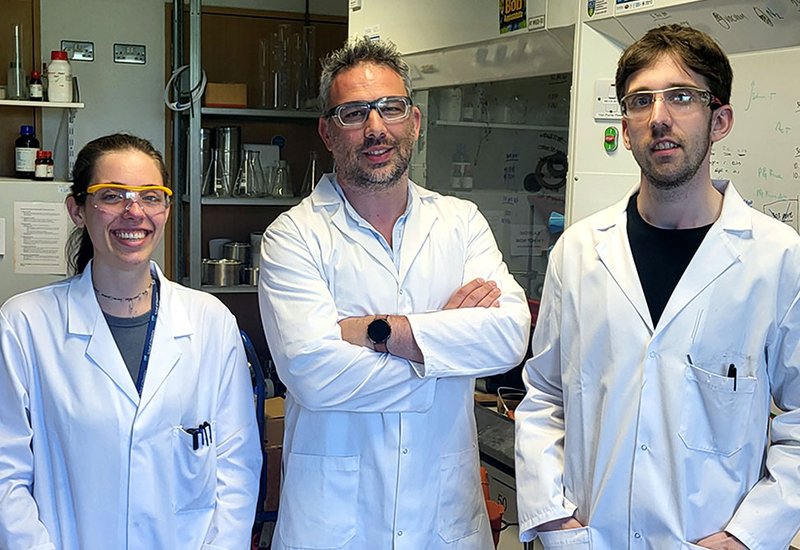
The Palma group on campus on a glorious sunny day in Dublin. Left to right: Aniello Palma, Camilla Di Girolamo, Antonello De Angelis, and Hubert Rebow.
The Palma Research Group in Dublin currently includes three Ph.D. students: Camilla Di Girolamo, who led the cyclo-polyproline study as its first author, Antonello De Angelis, and Hubert Rebow. Palma tries to keep recruiting as open as he can, drawing on the peptide community but also on the many dedicated virtual platforms now available to early-career PIs. Mentoring, he says, was one of the main reasons he wanted an academic career in the first place. “Seeing the growth of a student into a scientist is very rewarding.”
It is also, he has found, the part of the job that carries the most weight. Asked what surprised him most about running a lab, he sets aside the practical learning curve, the procurement software, the recruitment systems, none of which anyone warns a senior postdoc about, and lands on something less tangible. “The profound sense of responsibility you feel for your team members,” he says. “Wanting them to do well.” That feeling, more than any administrative detail, is what separates being part of a lab from running one.
When he describes how he wants to lead, he describes his mentors. He counts Donal O’Shea, Anthony Barrett, and Oren Scherman among the PIs who shaped him, and adds Prof. Philip Parsons, whose group shared a lab with his at Imperial and who became a good friend rather than a formal collaborator. “From each of them, I picked up things I knew I wanted to bring to my own group,” he says. “Simple things, like dedication, a positive leadership style, genuine trust in the team, and being kind and approachable with students. Who I am professionally today is a mix of what I learned from all of these mentors at different stages of my career.”
“The most impactful research often happens at the intersection of different fields.”
Before Dublin, Palma had already taken his first independent steps elsewhere. He launched his career as a principal investigator at the University of Kent, starting just before the pandemic, then moved home to Ireland and his current post as Assistant Professor in Medicinal and Organic Chemistry, which he began in January 2023. The pattern of movement across countries and institutions is not incidental to who he is. “Mobility is an incredible, yet often overlooked, part of a scientific career,” he says, noting that the EU’s Marie Skłodowska-Curie program makes it a near-requirement in any case. His time at Cambridge, embedded in a long-term collaboration with the Physics department, taught him a lesson he now treats as central. “The most impactful research often happens at the intersection of different fields.” The personal dividend is just as real. “You end up with lifelong friends in every corner of the globe.”
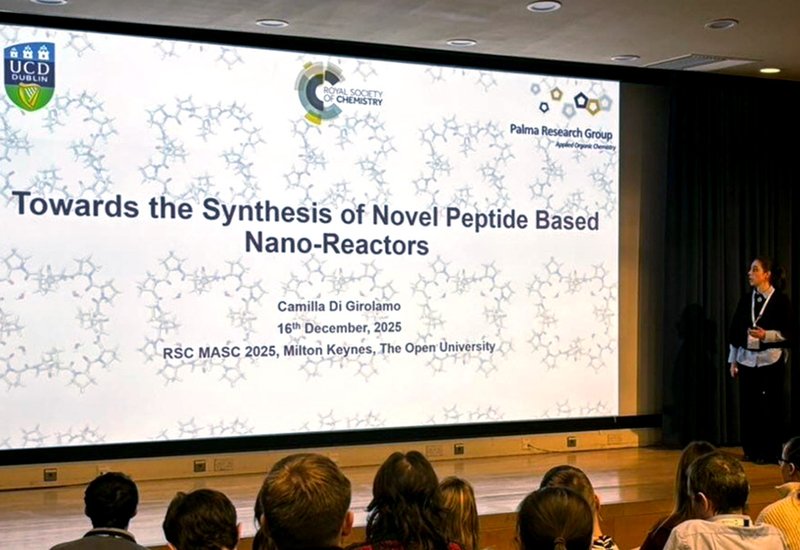
Palma has not yet attended an APS symposium, though he is quick to say it is on his list. His most recent foray into the peptide and protein community came as an early-career speaker at the first RSC Protein and Peptide Science Group symposium in Nottingham in December 2025, an occasion he describes as a fantastic chance to introduce his group to the wider field. “These meetings are very important for gaining exposure and meeting leaders in the field,” he says. Of the APS specifically, he speaks as an enthusiastic newcomer who has been watching from a distance. “I have been following the APS online and can see it is an incredibly active and vibrant community. I am eager to become more involved and hope to meet many of you in person soon.” What he hopes to bring is straightforward: his group’s unique perspectives and research interests, and a hand in the community’s continued growth.
His earlier recognitions sit lightly on him. He was awarded the BOC Gases Award for best Ph.D. research project and an Oxford University Press award for best Ph.D. thesis, distinctions he is almost reluctant to mention given how many years have passed. They are, nonetheless, early markers of a scientist who has been doing careful, original work for a long time.
There are, in truth, two homes in Aniello Palma’s story. Dublin is one, the city where he trained and to which he has returned. The other is Naples, the city he left twenty years ago and has never quite let go of. “I try to keep a strong connection to my roots,” he says. “I love keeping Neapolitan traditions alive in our house, like making classic dishes for the holidays.” He is a devoted supporter of his hometown football club, SSC Napoli, and follows the team closely, in part because it keeps a line open to family and friends back in Naples, a standing reason to call home and talk through the weekend’s result. The rest of life he keeps deliberately balanced around his wife, Patricia, and two daughters, Joan and Helen, walks through the natural beauty of Ireland, and beaches on both Irish and Italian coasts.
For the postdoctoral researchers coming up behind him, eyeing the faculty market, his advice is unsentimental and hard-won. “This is a very challenging question,” he admits. “Unfortunately, the academic job market is a narrow funnel, and there just aren’t enough faculty positions for every brilliant, worthy postdoc out there.” His counsel is not a strategy but a disposition. “My biggest piece of advice is to build up your resilience. I faced plenty of my own rejections during the process. You’re going to face them too, but you can’t let them define your worth.”
“You’re going to face them too, but you can’t let them define your worth.”
Five years out, Palma hopes to have made real headway on the problems that drew him into peptides in the first place: designing synthetic enzymes and peptide mimetics, and consolidating his lab’s standing internationally. Success, as he defines it, is not only his own. “My aspiration is for our outputs to be impactful and able to move the field forward, and maybe spark some new ideas for other researchers along the way.” What keeps him going is the openness of the question itself. “What keeps me excited is the unknown journey ahead: what can we achieve with these biomolecules, which scientific areas can we impact, and what new collaborations can we forge?”
For a scientist who arrived at peptides late and from an unexpected direction, that sense of an open road suits him. The latecomer, it turns out, may have shown up at exactly the right time.